UN Regulation R151/R159/R158
View More










Commercial fleets enter 2026 under pressure from several directions at once: tighter vehicle-safety regulation, persistent driver shortages, higher insurance and collision costs, growing privacy expectations, and an expanding mix of cameras, artificial intelligence and connected-vehicle data. In this environment, driver monitoring and safety systems are no longer optional accessories purchased only after a serious incident. They are becoming part of the vehicle’s core safety architecture and the fleet’s daily risk-management process. The important question for operators is therefore changing from “Does the vehicle have a driver-facing camera?” to “Can the system reliably identify risk, warn the driver at the right moment, protect personal data and help the fleet prevent the next event?”
That distinction matters. A basic camera can produce footage, but footage alone does not reduce risk. A modern platform must combine real-time sensing, contextual AI, vehicle data, event recording and a practical response workflow. The most competitive solutions in 2026 will be those that deliver measurable safety outcomes without overwhelming drivers or managers with false alarms, disconnected dashboards and low-value video.
Europe will be one of the clearest market drivers in 2026. Under the EU General Safety Regulation, Driver Drowsiness and Attention Warning requirements already apply to all new vehicles in the relevant scope. Advanced Driver Distraction Warning, or ADDW, has applied to new vehicle types since 7 July 2024 and extends to all new vehicles in categories M and N from 7 July 2026. For manufacturers and Tier 1 suppliers, the 2026 date makes driver distraction detection a production, homologation and platform-integration issue rather than a future roadmap item.
For commercial vehicle buyers, regulatory compliance will increasingly establish the minimum acceptable level—not the final purchasing argument. Operators will still ask whether a solution works across trucks, buses, coaches, vans and special-purpose vehicles; whether it performs with different driver heights, eyewear and lighting conditions; and whether it can be calibrated and serviced efficiently. Suppliers of driver monitoring and safety systems must therefore translate type-approval language into fleet value: fewer fatigue and distraction events, consistent warnings, easier deployment and defensible safety records.
The market will also become more sensitive to the difference between functions. Drowsiness, visual distraction, mobile-phone use, smoking, seat-belt status and driver absence are related but not identical risks. Each requires appropriate sensing, thresholds and warning logic. Buyers should avoid treating a long feature checklist as proof of regulatory compliance or real-world performance. The key questions are which functions are validated, under what conditions, for which vehicle categories and with what response time and false-alert rate.
Earlier monitoring products often depended heavily on one indicator, such as eyelid closure or head direction. In commercial operations, that can be too narrow. A driver may look toward the road but still be cognitively distracted, while sunglasses, vibration, night driving, changing sunlight or partial facial obstruction can reduce the confidence of a single camera-based measurement.
The 2026 trend is toward multimodal risk assessment. A stronger system can combine eye closure, blink behavior, gaze direction, head pose, yawning, phone-use detection and steering or lane behavior. When available, it can also use speed, turn signals, braking, time on task, route context and ADAS events. The purpose is not to collect more data for its own sake. It is to determine whether a behavior is actually dangerous in the current driving context.
For example, a short glance toward a mirror during a lane change should not be treated like prolonged eyes-off-road behavior at highway speed. Looking down while the vehicle is parked is different from looking down while approaching a pedestrian crossing. Better sensor fusion gives driver monitoring and safety systems the context needed to distinguish necessary driving behavior from genuine risk. This improves warning quality and makes drivers more likely to trust the system.
Commercial fleets should ask suppliers how their detection logic handles uncertainty. Does the product declare camera blockage or degraded performance? Does it distinguish “no driver detected” from “face temporarily obscured”? Can thresholds be configured without weakening compliance? A system that knows when it cannot make a reliable judgment is safer than one that produces a confident but incorrect alert.
Many first-generation safety deployments focused on how many events a system could detect. In 2026, the better success metric will be how many useful interventions it creates. Excess alerts quickly lead to warning fatigue, driver resistance and overloaded safety teams. If every glance, bump or vibration becomes an event, managers stop reviewing the queue and drivers learn to ignore the warning.
The solution is a layered alert strategy. Immediate in-cab warnings should be reserved for behavior that the driver can correct at once, such as sustained distraction or emerging drowsiness. Repeated or higher-severity events can trigger escalation, video review or coaching. Fleet managers should receive prioritized exceptions rather than an endless stream of clips. The most valuable systems will group repeated behavior, identify trends and show which drivers or routes require attention.
This changes procurement criteria. Accuracy remains important, but fleet buyers also need to evaluate sensitivity, specificity, event severity logic, warning latency and the management burden created by the platform. A technically impressive AI model can still fail commercially if it adds hours of video review each week. Effective driver monitoring and safety systems should reduce the safety team’s workload while improving its ability to act.
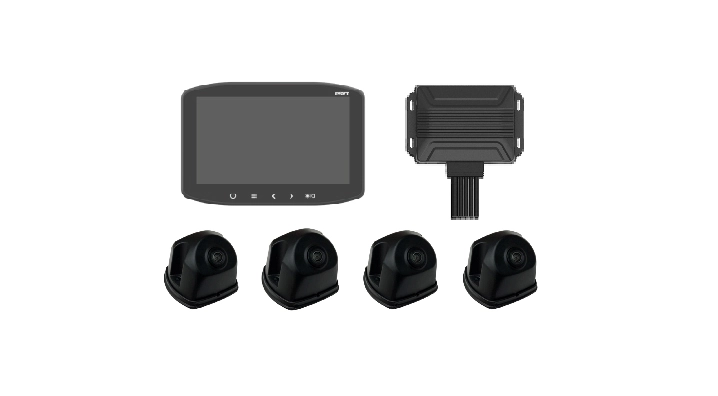
Driver state explains only one part of a road event. The external environment explains the other. This is why driver monitoring is converging with Advanced Driver Assistance Systems, blind-spot detection, Moving Off Information Systems, 360-degree Around View Monitoring and mobile digital video recording.
Consider a near collision during a left or right turn. A driver-facing event may show that the driver looked away, but external cameras can reveal a cyclist entering the blind zone, while vehicle data confirms speed, braking and turn-signal use. Together, these inputs create a more accurate account of cause and response. They also allow the system to issue more intelligent warnings—for example, increasing urgency when driver distraction and an external vulnerable-road-user risk occur at the same time.
For fleets, this convergence creates a stronger business case. One integrated platform can support real-time prevention, post-event evidence, claims investigation, coaching and operational review. It can also reduce duplicated cameras, wiring, displays and communication modules. The goal is not simply to add recording to every safety product. It is to preserve the seconds before and after a meaningful risk event so managers can understand what happened and decide what to change.
This is particularly relevant for buses, urban delivery vehicles, refuse trucks, construction fleets and heavy goods vehicles operating around pedestrians and cyclists. In these applications, driver monitoring and safety systems should work with outward-facing AI rather than operate as an isolated in-cab feature.
A driver-facing camera processes information that employees may reasonably consider sensitive. Regulations and labor expectations will push fleets to be more precise about what is collected, why it is collected, where it is processed, who can see it and how long it is retained. The EU General Safety Regulation specifically limits continuous recording and retention for mandatory drowsiness and distraction functions, requiring data to remain limited to what is necessary within the closed-loop system and to be deleted after processing.
This favors edge AI: analyzing video inside the vehicle and transmitting only a defined alert, score or event clip when policy allows. Edge processing reduces dependence on network coverage, shortens warning latency and can limit the amount of identifiable footage sent to the cloud. It does not automatically solve privacy, but it gives fleets better technical tools for data minimization.
In 2026, a credible supplier should be able to explain privacy controls in operational terms. Can inward-facing video be disabled while risk metadata remains available? Are event clips encrypted in transit and at rest? Can access be controlled by role? Are viewing and downloading audited? Can retention periods differ by event type or jurisdiction? Are over-the-air updates authenticated and protected?
Cybersecurity belongs in the same conversation. A connected camera with access to vehicle signals is an endpoint that must be secured throughout its lifecycle. Buyers should evaluate secure boot, signed firmware, vulnerability response, credential management, software-update procedures and separation between safety functions and remote services. Trustworthy driver monitoring and safety systems must protect both the vehicle and the people whose data they process.
Technology alone does not create a safety culture. If drivers believe monitoring exists only to punish them, they may resist the system, obscure the camera or dispute every alert. A coaching-led deployment sets a different expectation: the technology identifies preventable risk, the driver receives fair feedback and managers use consistent evidence to support improvement.
The most effective programs will combine immediate warnings with structured coaching. A manager might review repeated phone-use events, recognize improvement over time and reserve disciplinary escalation for serious or persistent behavior. Positive indicators—safe driving streaks, reduced high-risk events or rapid correction after an alert—can also be recognized. This makes the system part of professional development rather than an invisible disciplinary mechanism.
Transparency is essential. Before deployment, fleets should explain which behaviors are detected, when video is saved, who reviews it and how an event can be challenged. Policies should apply consistently across drivers, depots and managers. Where employee representatives or works councils are involved, early consultation can reduce friction and expose policy gaps before rollout.
The quality of the coaching interface will consequently become a product differentiator. Safety teams need searchable events, concise evidence, configurable workflows and trend reporting—not simply a live-view screen. FMCSA research has also examined multimodal fatigue and distraction detection for commercial motor vehicle drivers, reinforcing the value of combining reliable detection and timely warning in this sector.
In 2026, fleets will be less willing to fund technology based only on demonstrations or AI accuracy claims. They will expect suppliers to support a measurable pilot and a scalable deployment. Useful indicators may include fatigue and distraction events per 1,000 driving hours, repeat-event rate, collision and near-miss frequency, preventable claims, coaching completion, driver acceptance and time spent reviewing alerts.
A well-designed pilot should establish a baseline before alerts or coaching change behavior. It should include representative vehicles, routes, shifts and drivers, and it should separate technical performance from program outcomes. Detection accuracy answers whether the device recognizes an event. A reduction in repeated risky behavior answers whether the overall intervention works.
Scalability also extends beyond the first vehicle. Fleets should examine installation time, camera-position tolerance, calibration, remote diagnostics, data usage, storage options, API availability and integration with existing telematics or video platforms. Global operators need language support and policy controls that can accommodate different legal environments. OEM and Tier 1 programs need stable hardware, documented interfaces, cybersecurity support and a credible product lifecycle.
This is where open integration becomes strategically important. A platform that can share standardized event metadata with fleet-management, ADAS or cloud systems is more valuable than a closed device that requires another dashboard. The future of driver monitoring and safety systems lies in turning driver-state insight into a usable part of the wider vehicle and fleet ecosystem.
Fleet leaders do not need to replace every safety product immediately, but they should define a clearer architecture. Start by identifying the highest-cost and highest-frequency risks in the operation. Long-haul fleets may prioritize fatigue; urban fleets may focus on distraction combined with pedestrian and cyclist exposure; bus operators may require both driver-state monitoring and passenger-area evidence.
Next, translate those risks into testable requirements. Specify detection scenarios, warning behavior, privacy rules, event-retention policy, integration needs and pilot metrics. Test the system in real operating conditions, including night driving, eyewear, different cab layouts, vibration and variable network coverage. Involve drivers early and document how alerts will lead to coaching or escalation.
Finally, evaluate the supplier as a long-term safety partner. Commercial vehicles often remain in service for many years, and AI performance, cybersecurity threats and regulations will continue to change. Fleets need a roadmap for software updates, technical support, replacement components and regulatory adaptation—not just a one-time hardware sale.
The commercial vehicle safety market in 2026 will not be defined by the number of cameras installed. It will be defined by whether fleets can convert reliable detection into timely intervention, fair coaching and measurable risk reduction. Regulation will accelerate baseline adoption, but operational performance, privacy, integration and driver trust will determine which deployments create lasting value.
For fleet operators, the best strategy is to treat driver monitoring and safety systems as part of a connected safety architecture. The right platform should understand driver condition, consider the road environment, warn without creating unnecessary noise, preserve useful evidence and give managers a practical path from insight to action. Suppliers that can deliver this complete loop will move beyond selling devices and become genuine partners in safer commercial transport.